Tuesday, November 23, 2010

A Happy Thanksgiving and All of the Trimmings

Wow - I've found a lot of garden material to post on our facebook page in the last few days! Unusual for this time of year, but it certainly helps to brighten these grey overcast days at the end of November. There is not much to be done outdoors so at least we can enjoy some good material. Here are some of the interesting links I have come across, think of it as a Thanksgiving menu with lots of goodies to choose from:

- First is the preview from a pictorial book featuring photographs from some of this summers Garden Conservancys Open Days Program. Beautiful shots.
http://www.blurb.com/bookstore/detail/1702882?ce=blurb_ew&utm_source=widget

- Food and flowers - sounds like a good holiday to me! Here are links to two pictorials from Garden Design Magazine to inpire your Thanksgiving table centerpiece! Garden Design is one of my favorite design resources and I am so happy that they are regularly poting articles and slide-shows!
http://www.gardendesign.com/
Power Flower:Six flower arrangements for your holiday table by our favorite floral designers. Six flower arrangements for your holiday table by our favorite floral designers.
and
Brooklyn Style: Autumn Floral Design with Kat Flower Garden Design
Claire Lui spends a day learning floral design with kat flower at the Brooklyn Flea market.

- Fishing for Food - An interesting and promising idea, I ran experiments on this topic for a project in college; Aquaponics, a method of growing fish and plants together, creates a closed loop system that some say could help to address food shortages in places without access to fresh produce. NBC's Anne Thompson reports.
http://www.msnbc.msn.com/id/21134540/vp/40203746

- Finally something good from a politician, Garden Design Magazine posted this pictorial tour of a Pennsylvania State Representatives sustainable home and landscape.
http://www.gardendesign.com/
Green Proving Ground Garden Design
Tour of a sustainable homestead in rural Pennsylvania

- Backyard Buffet? A whole new meaning for the term "outdoor kitchen" from NPR:
The Thanksgiving drill is pretty familiar: turkey, stuffing, pumpkin pie. But what would Native Americans have brought as sides? Turns out your backyard might have something tasty to contribute to this year's feast.
http://www.npr.org/
Try Foraging For Your Thanksgiving Meal : NPR
The Thanksgiving drill is pretty familiar: turkey, stuffing, pumpkin pie. But what would Native Americans have brought as sides? Turns out your backyard might have something tasty to contribute to this year's feast.

- No one does the holidays like Longwood. Imagine half a million brilliant lights strung with over 39 miles of cord. Lit trees the soar 75 feet, and dancing fountains that reach the sky. A 4.5-acre heated indoor Conservatory, featuring the richest floral displays imaginable. A Longwood Christmas is a celebration months in the making with hundreds of amaryllis, cyclamen, narcissus, literally thousands of poinsettias and special performances throughout the holidays. The season begins November 25, 2010 to January 9, 2011

- If you thought Christmas Trees were a lot of work to raise and prune, check out the topiary artistry of Pearl Fryar! If you would like to visit a topiary garden closer to home try Ladew Gardens in Monkton, MD. They are hosting a 'Gardeners Christmas' December 10-12.
http://www.pearlfryar.com/

Tuesday, November 16, 2010

It is the little things that make the difference

It is the little things that make the difference

One of our office buildings was re-painted this summer. Since we rent the space, we didn’t have any say in the selection of the contractor hired. The property manager spoke with several companies before choosing someone who met the minimum requirements; insurance and experience, and who offered the cheapest price. Now don’t get me wrong, price matters – but so do details.

The workers were nice enough, but inconsiderate of the businesses being run there. I never knew when they would show up for work, or not. Each day that they were there, they blocked my vehicle in. I had to ask them to move so I could leave for appointments….each and every day, and they were there for months, many more than expected, then left trash behind when they were done.

Now that fall has come and they are finally done, their lack of careful detail has become evident. The other day I began to insulate the windows for winter; clean the glass, put down the storms and latch the sashes. I was frustrated to find that most of the windows had been painted shut, some of the storms were put on incorrectly and the outside of each window was left filthy with paint smudges and debris from power washing. These are the sort of details that would have taken the contractor only minutes to address during the project – but now instead require hours for me to remedy.

This is not just a chance for me to vent but an opportunity to relate my first hand experience to potential customers as they interview contractors and compare bids for their landscape projects. Many times the reason for price differences are the quality of materials, methods of construction or size of the project being proposed, but other times it is simply the level of detail that one contractor offers. Materials, methods and size can all be adjusted for, unfortunately the level of detail is an intangible variable. Details don’t always affect the quality or safety of an installation, but they do affect the quality of life for those who live with the project and who, for a short period of time, have to live with the construction process and the contractors performing it.

The personal details critical to a landscape installation include, of course, being polite, keeping the area free of trash and debris, maintaining a consistent schedule and good communication about the progress, minimizing the inconvenience to homeowners and neighbors so that their vehicles, paths and views are not blocked, property lines and drainage are respected, lawn and plant damage are kept to a minimum, abiding by reasonable work hours and noise levels, keeping soil and mulch piles contained and cleaning up spills or tracks promptly. (I have a whole other entry on the responsibilities of being a great client including offering cool drinks and saying 'hello' to the crew!)

Construction and finish details are less obvious to most homeowners. They include consistent joints in stone work, cleaning up excess mortar from surfaces, making clean geometric cuts and corners, smoothly grading and seeding any tracks or disturbed areas. Some of them are even unseen. For example, we solder all of our underground low-voltage lighting wires and use silicone filled wire nuts to attach the fixtures. These are details that the homeowner will never see but that have a crucial role in the future function and longevity of the project just as a properly prepared base does. Polymeric sand used in patio joints, conduit installed beneath walkways and downspout extensions all offer similar hidden benefits.

To determine if a contractor regularly includes these details ask how they address the particulars, speak with their clients, see photos or visit completed projects and if possible visit a site under construction or ask to see progress shots so you can assess the conditions maintained during construction. Sometimes it is worth paying a little extra to know that the contractor you are working with has included these extras and offers the sort of customer service that will allow them to come back and address any problems.

Thursday, November 4, 2010

Form and Function


Form and function are the equivalent of beauty and intelligence to architecture. Of course any design element needs to perform its job well but a well-designed element does it beautifully.

The Tripp family of Montgomery County contacted us at Martin Shaw, LLC needing to accomplish two important goals. Their home sits on the corner lot of a busy development and had no privacy. Lots in the neighborhood are small and the Tripps needed a way to access their backyard from a second story door while staying with-in the limited building envelope. They needed a staircase, patio and privacy but wanted an attractive entertaining space, garden and yard that their growing family could enjoy. I won’t lie; their design was a challenge. I played with a number of ideas, shapes and elevations, coming to dead ends several times after realizing my concept did not fit the requirements. It may be hard to believe but the smallest projects can often be the most difficult, but also offer the greatest satisfaction.

Sure enough, we finally came up with a solution that would give the homeowners an expanded grilling and entertaining space on the upper floor, then get them efficiently to a ground level patio, given privacy by some of their favorite trees and shrubs. To minimize the need for furniture surrounding the fire pit they wanted, we designed a seating wall to allow for efficient use of the small patio. Additional storage was created beneath the proposed deck. Since this landscape had to look as beautiful as it functioned we chose a random pattern bluestone patio complimented by bluestone veneer and caps on the wall. Landscape lighting creates safety while emphasizing texture in the stone wall and highlighting the shape of specimen trees.

The Tripps Georgian Colonial style home is built in a neighborhood of mixed American and European styles. Their homeowners association created guidelines designed to encourage individuality and an organic neighborhood feeling to the development. The HOA Manual of Design Guidelines requires that the landscape of each home remain appropriate to the architecture. Our design philosophy is to create landscapes appropriate to the home, but with a mandate to follow it was especially important to honor the traditional style of the house and allow for the eclectic style of their neighborhood. The bluestone patio, wall and all plantings reflected the traditional historical nature of their architecture. Many of the plants used are native to South Eastern Pennsylvania, while others are English garden classics used by generations of settlers to the area. Privacy is created by a hedge of Arborvitea. In consideration of drivers though, the hedge does not extend to the corner where it could obstruct the view of on-coming traffic.

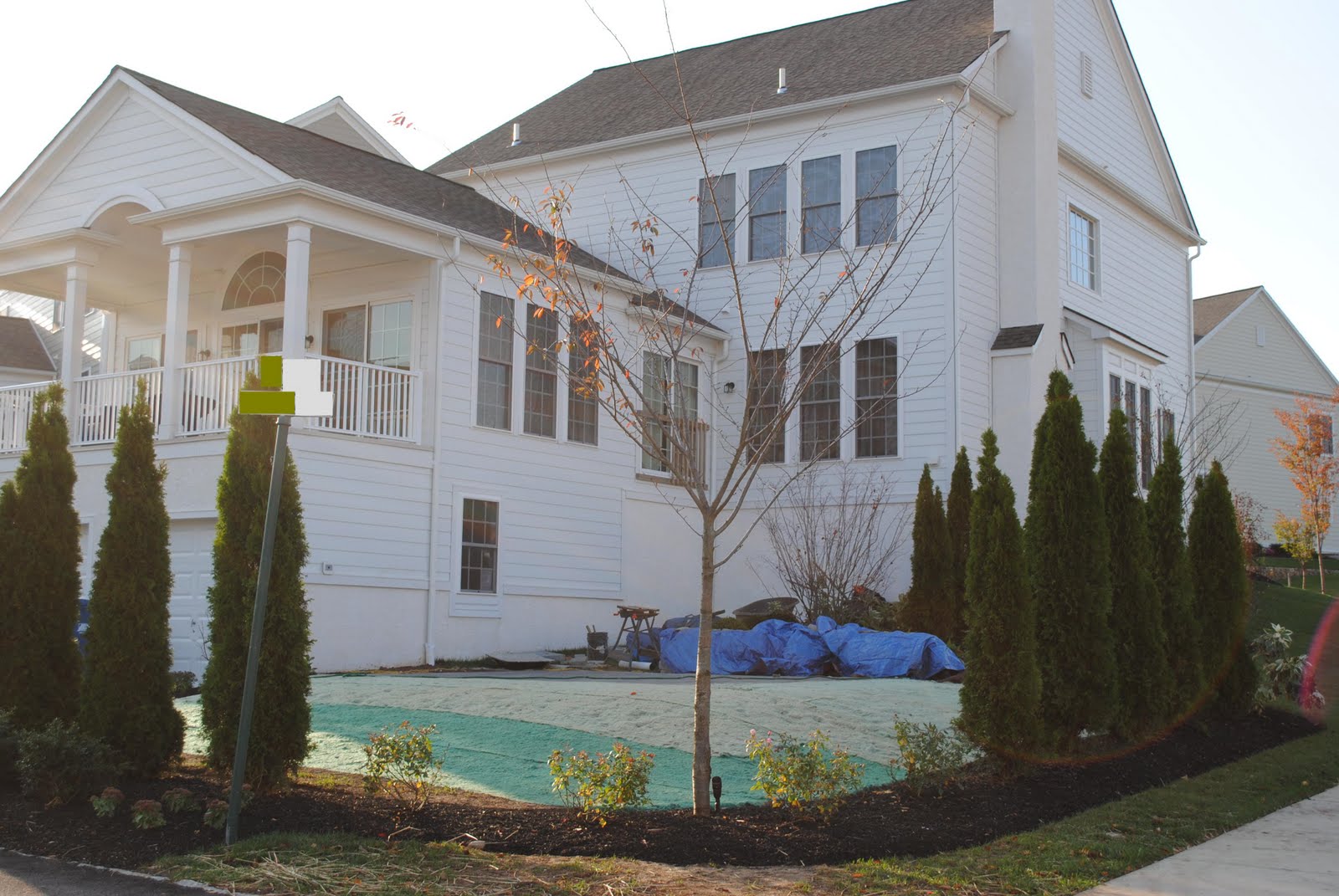
To meet budget concerns the project has been broken two phases; the patio and plantings were completed this fall, the deck and steps are proposed for installation in the coming spring. The following photos illustrate our design and progress of the construction thus far. It may look simple now – but, just wait until the deck is complete and the plants have leafed out! With the Yoshino Cherry, Lilac, Peony and Serviceberry in spring bloom this little project will be a big attraction. Most importantly though our clients are enjoying it in the fall, even at this phase, when they can finally use that fire pit they have been waiting for.

Tripp Project Photos


(Yes, the grass was photo-shopped into this photo - it was dirt at the time - but the remaining image is untouched.) 


Thursday, October 21, 2010

A Palette of Pumpkins

One of the most beautiful fall photos I have ever seen and a great introduction to autumn gourds from the 'Queen of Halloween':

A Palette of Pumpkins
Martha Stewart Living 2008

Some sit bulging and broad, secure in their squatness. Some stand tall.

They are pear-shape. They're ellipsoidal and spheroidal. They can be wide-shouldered or slump-shouldered. The biggest ever approached a ton; the smallest would barely tip the needle on a bathroom scale.


The colors of their skin also vary enormously. Start with every tint of orange, of course, from amber to apricot, coral to persimmon.

Then envision inky black or ghostly white; buttercream or slate blue; sage green or darkest myrtle. Some favor even more outlandish hues: baby pink; mustard; salmon; shiny, fiery red. Some aren't content with a single shade at all, so they tart themselves up in stripes, mottles, marbling, and speckles.

Welcome to Cucurbita, the genus of pumpkins, squashes, and some gourds -- the edible and ornamental fruits of fall. And once you recognize the variety of shapes and shades, all kinds of decorative possibilities open up. Why stick to the standard orange icon of fall? Think pale and monochromatic, bright and bold, eerily enigmatic, or elegantly dark and moody.


Although the pumpkin did not become associated with Halloween until the mid-nineteenth century, its cultivation has been traced as far back as 8000 B.C., to Mesoamerica, where it was grown for its tasty seeds, not its pulp. American Indians taught the pilgrims how to cultivate them, and the seeds eventually made their way across the oceans, to every corner of the globe except Antarctica.


Thank the reproductive indiscretions of the domesticated species for a stunning variety of shapes, sizes, colors, and even ethnicities. Kabocha, the so-called Japanese squash, sports knobby black-green skin that's often striped in celadon. The rinds of Australian squashes, such as 'Jarrahdale' and 'Queensland Blue,' vary from dusty gray to greenish blue.

French pumpkins, such as the elegant 'Rouge Vif d'Etampes,' dubbed the Cinderella pumpkin, tend to be low to the ground and often display deeply ridged lobes. 'Iran,' a large, smooth-skinned heirloom, seems painted with splashes of green, gray, white, and persimmon.


'Galeuse d'Eysines' and 'Marina di Chioggia' are both pocked with bumps caused by a buildup of sugars underneath their skin and look scary even before they're carved.


There are five common species of Cucurbita: ficifolia (chilacayote squash and Malabar gourd), maxima (Hubbard, 'Lakota,' buttercup, and winter squashes), mixta (cushaw squash), moschata ('Shakertown Field' and 'Long Island Cheese' pumpkins), and pepo (jack-o'-lantern varieties, delicata squashes, ornamental gourds).

The wanton willingness of each species to cross-pollinate with members of its own tribe can create some curious offspring.


So fashion a Gothic statement with the darkest squashes of Asia. Echo the golden colors of foliage in a centerpiece. Carve a lacy belt around the centers of an array of pale pumpkins. Go ahead. Embrace the global goblin globe. Don't be afraid.


Read more at Marthastewart.com: Search 'Pumpkins' or 'Gourds' for more great ideas!

"Martin" Shaw has a degree in "Gourd-iculture"


Creek Indians in America used gourds for centuries as Purple Martin Bird houses as well as for storing and protecting their corn from the animals. Purple Martins eat flying insects captured in flight, including many larger flying insects which has led many farmers and rural homes to make Purple Martin gourds to attract them. The Creek Indians realized this and for centuries they grew large kettle shaped gourds for the purpose of housing Purple Martins for insect control. Once Purple Martins have adapted a suitable nesting ground, as long as their homes are taken care of, cleaned or replaced yearly, they will return along with the next generation. Some Purple Martin lovers literally have an annual nesting of 100's to 1,000's of Purple Martins.

One of the most interesting aspects of Purple Martins is they are the only bird in North America that has developed a total dependency on Humans for their existence. Without humans providing nests for Purple Martins, they would rapidly become a rare, if not extinct bird in America due to a loss of their nesting places. Before humans provided them nesting homes, they used old woodpecker nests, but woodpecker nests are normally only found in standing dead trees which which now are generally cut down and cleared by man for new growth or for fire wood.


Digital Gourds chart © Dan Dunkin 2003
This chart is used courtesy The Gourd Reserve

Tuesday, October 12, 2010


Overseeding:
Do it Now in the North

by Paul Tukey of Safelawn
www.safelawns.org

With Columbus Day here, folks in the most northern states in the U.S. and much of Canada are running out of time for overseeding the lawn. Late summer and fall is the best time for this activity in general, but the clock long ago started ticking on the ideal window.

The issue is that the young grass plants need time to establish themselves before it gets bitterly cold. Any seed mix you put down now should probably have Kentucky bluegrass and perennial ryegrass in a high percentage; the ryegrass because it germinates quickly and the bluegrass because it tolerates cold so well. Fescues are the best grasses overall for the North, but they do take a long time to germinate (14-21 days) and they are the most susceptible to cold damage of not fully established.

OTHER TIPS ABOUT SEEDING NOW:
1) If you do seed, be sure to rake away any excess thatch layer or dead grass first to create good seed to soil contact.
2) If you feel your soil is compacted, aerating prior to overseeding is a good idea;
3) Cover the newly seeded area with a thin layer of compost rather than straw; it will be cheaper and better for the lawn; it also looks better.
4) Water the newly seeded areas daily until they fully germinate, unless of course we get rain naturally.
5) Some people advocate dormant winter seeding, that is putting the seed down after the ground freezes and then letting nature take its course. The idea is that the grass will germinate on its own by spring without the necessity of daily watering. I’m not a fan of this, however, because so many things can go wrong (birds eating it, freezing and thawing, erosion etc.) between now and then.
6) Applying an organic fertilizer rich in potassium this fall will help the lawn through winter.
7) Don’t mow the lawn for the first time until the young grass seedlings are four inches tall.
Don’t allow the leaves to remain on the lawn, especially in the newly seeded areas; the leaves will mat down the grass. You may find you have to rake lightly, or use a blower, to remove heavy layers of leaves.